On June 28, 1776, South Carolina Patriots successfully defended Sullivan’s Island against a British naval assault. The fort used native palmetto logs to absorb cannon fire. Unlike traditional hardwoods, the spongy palmetto wood swallowed iron balls instead of shattering, allowing the garrison to withstand the bombardment and repel the fleet.
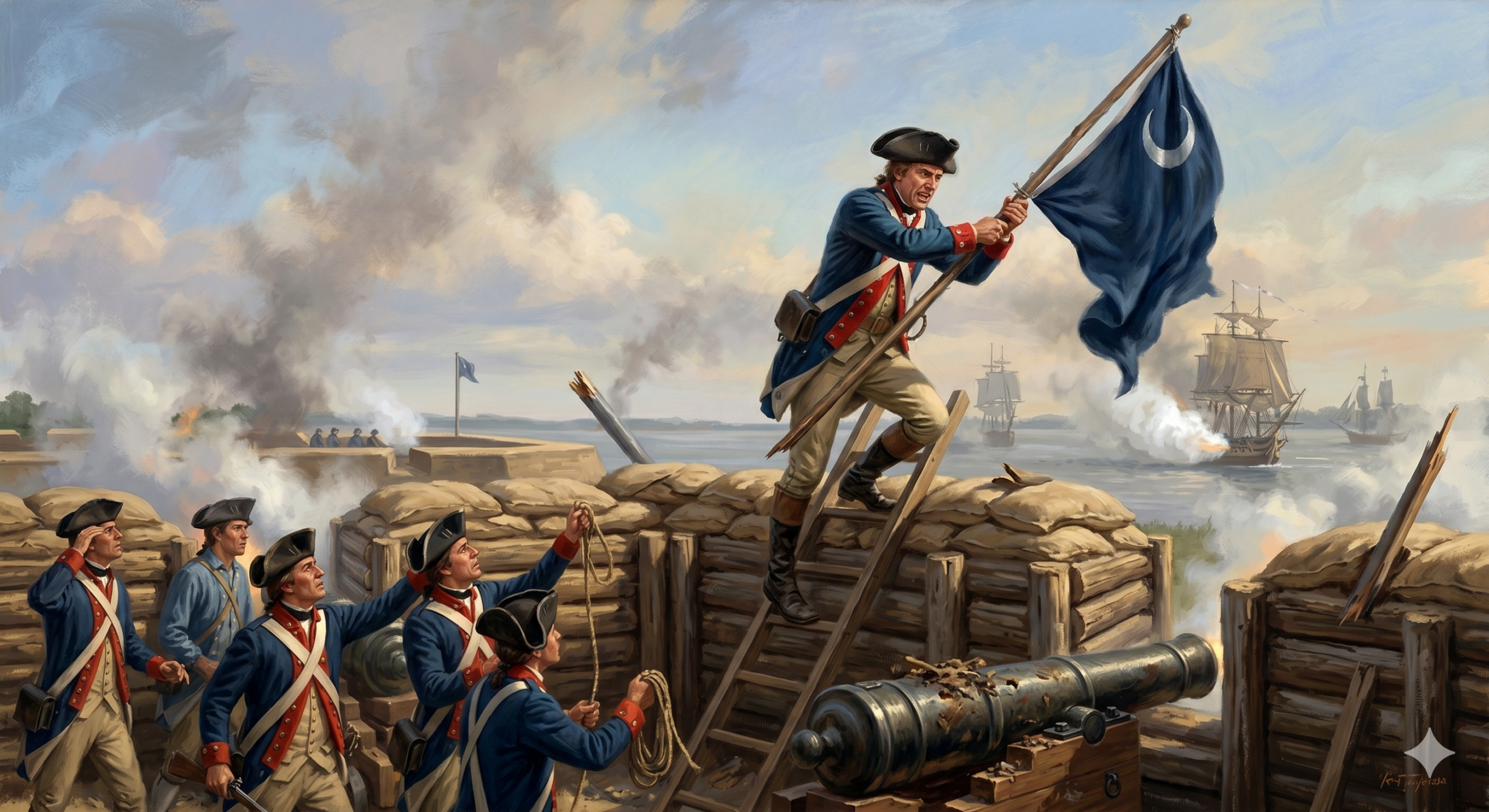
During the battle, Sergeant William Jasper risked his life to retrieve the fallen flag, signaling continued resistance to the British fleet. This victory forced the British to withdraw and established the palmetto tree as a symbol of American resilience. The event remains a significant moment in the Revolutionary War.
This post is part of an ongoing series, America 250.
The ultimate showdown between 18th-century military muscle and raw, accidental engineering took place on June 28, 1776, right here in South Carolina. Six days before the Declaration of Independence was signed in Philadelphia, a massive British fleet packed with over 200 heavy cannons dropped anchor off Charlestown Harbor. Standing in their way was an unfinished, rectangular dirt fort on Sullivan’s Island, manned by Colonel William Moultrie and a few hundred second-line Patriots.
The British expected a swift, brutal slaughter. They didn’t get one, all because of a humble, local tree: the Sabal Palmetto.
The Spongy Shield
Standard military strategy dictated building fortifications out of dense, rigid hardwoods like live oak. When a heavy iron cannonball hits oak, the wood splinters violently, sending lethal shards flying inward like shrapnel. But Moultrie’s men didn’t have time for oak. They built their fort’s double-layered walls out of native palmetto logs, packing the 16-foot gap between them with dense, wet beach sand.
When the British flagships unleashed their first massive broadside, something extraordinary happened. The palmetto wood was incredibly soft, fibrous, and spongy. Instead of shattering or fracturing, the logs simply flexed. They swallowed the kinetic energy of the incoming 32-pound iron balls, burying them deep inside the spongy fibers or spitting them harmlessly out into the sand.
British gunners watched in sheer disbelief as their devastating artillery fire was literally absorbed by the walls. The fort was quite literally swallowing their attack whole, allowing the Patriots to conserve their scarce gunpowder and fire back with devastating precision.
Jasper’s Defiance
As the grueling ten-hour bombardment wore on, a British shot snapped the fort’s flagship staff, sending Colonel Moultrie’s blue “Liberty” banner tumbling outside the walls onto the open beach. To the fleet outside, a fallen flag meant surrender. To the men inside, it was a crushing blow to morale.
“Colonel, the flag has fallen!” “Then we must bring it back.”
Sergeant William Jasper didn’t hesitate. Stepping out from the safety of the spongy fort, Jasper leaped through an open embrasure directly into a hail of active British cannon fire. He walked the exposed, exploding beach, retrieved the fallen banner, and climbed back up onto the ramparts.
Lacking a proper staff, he fixed the flag to a simple sponge-staff—the long wooden rod used to clean the cannons between shots. He drove it firmly into the sand, climbed back down, and calmly returned to his gun. That single act of defiance instantly rallied the garrison and signaled to the British that South Carolina had no intention of backing down.
America 250
By sunset, the humiliated British fleet cut their anchors and slipped away. The spongy palmetto had held, and Jasper’s bravery kept the spirit alive.
As we look toward the 250th anniversary of our nation, this story is the perfect example of revolutionary grit. The Patriots won not because they had better gear, but because they expertly adapted to their environment and refused to break under pressure. It’s the reason the palmetto tree proudly anchors the center of the South Carolina state flag today—a permanent monument to the day a spongy tree stumped the world’s greatest navy.
This post is part of an ongoing series, America 250.
We all know the image: Betsy Ross sitting in a sun-drenched room, hand-stitching the first Stars and Stripes. It’s a beautifully patriotic scene that we’ve been taught since elementary school. But what if the “First Flag” was actually a product of unpaid bills, 6-pointed stars, and a signer of the Declaration of Independence looking for payment in wine? As we approach America’s 250th anniversary, it’s the perfect time to peel back the layers of our national folklore. The real story of how the American flag came to be isn’t just about one woman with a needle and thread—it’s a fascinating look at wartime bureaucracy, design debates, and a PR campaign that started a century after the revolution.
The Wine-Loving Designer (Who Wasn’t Washington)
The legend tells us that George Washington, George Ross, and Robert Morris walked into Betsy’s Philadelphia upholstery shop in 1776 with a rough sketch in hand. In reality, Washington was a bit busy trying to keep the Continental Army from collapsing, and there is zero contemporary paperwork proving this meeting ever happened. Instead, historical evidence points toward a man named Francis Hopkinson. Hopkinson was a Renaissance man: a lawyer, a musician, a signer of the Declaration of Independence, and a member of the Continental Navy Board. He is the person who actually designed the flag elements. How do we know? Because he later sent a bill to Congress asking for payment for his design work. His requested fee? A quarter-cask of public wine. (Congress, being Congress, delayed and ultimately never paid him, arguing that others contributed to the design too).
The Six-Pointed Showdown
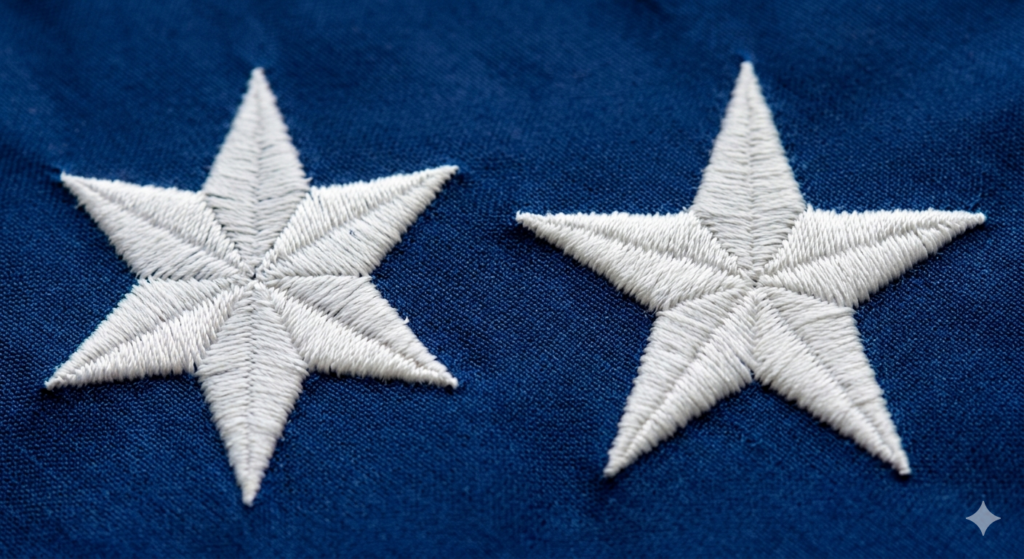
When Hopkinson or the committee originally drew up the stars, they weren’t the 5-pointed ones we know today. They featured 6-pointed stars (hexagrams), which were the standard in British heraldry. This is where Betsy Ross likely does enter the story. According to oral history passed down by her family, the committee wanted 6-pointed stars because they thought they would be easier to sew. Betsy allegedly took a piece of paper, folded it strategically, and with a single, elegant snip of her scissors, produced a perfect 5-pointed star. She proved that the 5-pointed star was actually more efficient for mass production. Whether this snippet of history is entirely true or not, the visual shift was profound: it gave the new nation a unique aesthetic, distinct from the British crown.
The Math Problem: Too Many Stripes
We take the 13 stripes and 50 stars for granted today, but the early evolution of the flag was absolute chaos. The original 1777 Flag Resolution was incredibly vague. It simply stated that the flag would have 13 alternating red and white stripes, and 13 white stars in a blue field, representing a “new constellation.” It didn’t specify how the stars should be arranged (which is why you see early flags with stars in circles, rows, or clusters), nor did it map out a plan for growth. When Vermont and Kentucky joined the Union, the flag was changed to 15 stars and 15 stripes (this was the “Star-Spangled Banner” that Francis Scott Key saw over Fort McHenry). But as more states lined up to join, Congress realized that adding a new stripe for every state would turn the flag into an unmanageable, oversized blanket. In 1818, they wisely capped the stripes permanently at 13 to honor the original colonies, letting only the stars multiply.
The Hidden Code of the Colors
While the design was being ironed out, the symbolism was being codified. When the Great Seal of the United States was adopted in 1782, the meanings of the flag’s colors were officially defined:
White: Signifies purity and innocence.
Red: Represents hardiness and valor.
Blue: Represents the chief, vigilance, perseverance, and justice. The stars, collectively, were meant to break away from the old world—a literal new constellation rising in the global political heavens.
So, Was Betsy Even the Original Seamstress?
Here is the ultimate plot twist: the world didn’t hear about the “Betsy Ross” story until 1870—nearly a century after the Declaration of Independence. Her grandson, William Canby, presented the story to the Historical Society of Pennsylvania based purely on family affidavits and memories. Did Betsy Ross exist? Absolutely. Was she a skilled Philadelphia upholsterer? Yes. Did she make flags for the government? Records show she was paid for making ship colors for the Pennsylvania navy. While she may not have single-handedly “invented” the American flag in a vacuum, Betsy Ross represents something incredibly vital to the America 250 story. She represents the thousands of women, tradespeople, and working-class colonists who didn’t sign the grand documents, but who used their tangible, everyday skills to physically sew the revolution together. The myth gives us a neat story, but the history gives us a beautiful truth: the American flag was a group project.