Flock Irony

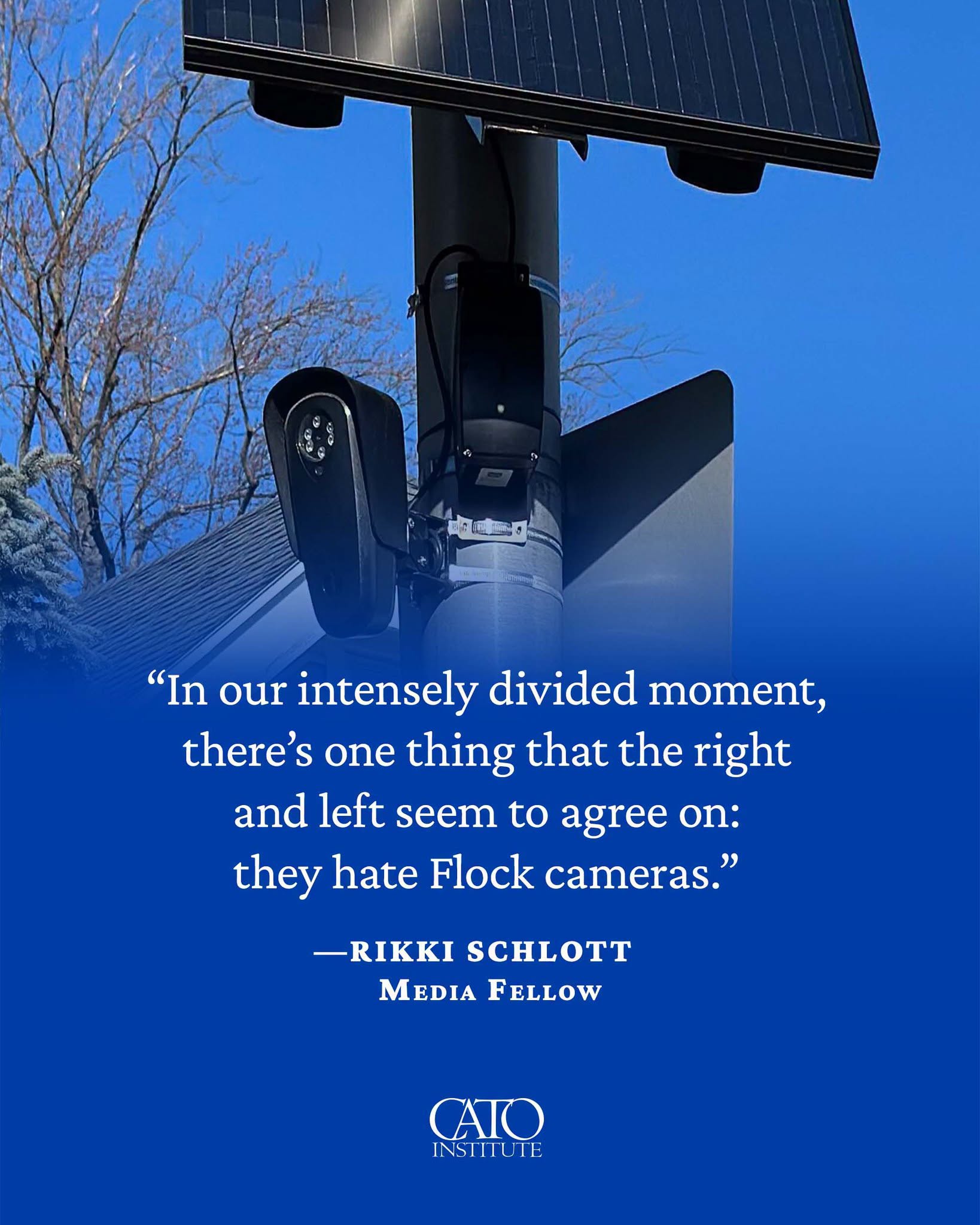
Flock worker calls police on InvestigateTV reporter filming public camera installation

The irony is the whole story, and the details make it sharper.

On August 19, 2026, Atlanta News First / InvestigateTV chief investigator Brendan Keefe got a tip from a family member that a Flock Safety technician was upgrading a license-plate reader on a public street about a mile from Keefe’s home in suburban Atlanta. He parked at a distance on the public road, put on a yellow safety vest and a station-logo hat, put a press placard on the dash, and started filming. He did not approach the worker or speak to him.

The installer saw the camera, packed up immediately, and left. Keefe followed several cars back—not bumper-to-bumper—hoping to document the next public install. The technician called 911. Forsyth County answered first and transferred the call. On the recording, the worker said he worked for Flock Safety, that he was “getting followed,” and that he was being “harassed, pretty much. Taking videos and pictures.” He described Keefe’s car and later Keefe himself, including the vest and hat. He also said he didn’t want his full name on the 911 recording.

Minutes later, after Keefe entered Milton, Georgia, one officer pulled him over. Two more units arrived. The stop lasted about 17 minutes. Keefe identified himself as press documenting camera installations. Bodycam shows the officer telling a supervisor that Keefe was behind the van but “not like right on his bumper,” was not chasing him, and did not appear to be stalking or breaking any law. The officer also relayed the installer’s concern: he was “just an employee,” didn’t want to be identified on TV, and worried about targeting of him or his family.

Keefe put the contradiction on the record: the company is installing cameras that track everyone’s movements in public, but the installer objected to being filmed in public. The officer said she was only passing along the worker’s concern, then added that media should “probably be a little more careful on who we put on TV.” No citation, no charge. Keefe was released.

Flock’s statement afterward: the company “does not object to members of the public or press photographing Flock cameras or personnel in public.” Field employees and contractors “are expected to prioritize their safety and may contact law enforcement when they believe they are being threatened, harassed, followed, or otherwise face a safety concern.”

That was not the only 911 call. In June 2026, a Flock employee at the company’s Smyrna, Georgia, distribution center called police on YouTube creators filming from public areas outside the facility. The caller identified the company as the one whose cameras “solve 20% of crime across America,” asked for “a favor,” and repeatedly raised the possibility the filmmakers might be armed even after saying he had not seen weapons. Police issued a trespass warning. No charges. One of the people there, security researcher Benn Jordan, later called it “absurd” that a company built on collecting everyone’s plate data would have staff scrubbing their own personal information.

The larger backdrop is the fight InvestigateTV and others have been documenting since early 2026: Flock’s network of roughly 120,000 ALPRs, reports of unauthorized or sloppy searches, cities canceling contracts, and the company arguing that a license plate is “plain-view information” you cannot opt out of unless you “opt out of society.” The installer who called 911 was doing the same thing the cameras do to everyone else—recording a person in a public place—and then treating being recorded as an emergency. That is the rest of the story.

Well Preserved Corpse

Congress Preemptively Holds State Funeral For Mitch McConnell

Mitch McConnell looks like a well preserved corpse.

The Lone Juror

I really want to see the holdout on the Lindsay Clancy jury interviewed with a black circle covering his face. Complete with the pitch-shifted robot baritone and moody, dim studio lighting—it really would look like an episode of 60 Minutes tracking down a cartel turncoat.

Given how thoroughly his fellow jurors just went on television and put him on blast, he’d probably need that level of disguise just to walk around Plymouth County. Between foreperson Ronni Carlson recounting how she had her pen out ready to sign the acquittal forms before he slammed the brakes, and another juror publicly calling him “very arrogant,” the target on his back is massive.

If he ever actually decides to break his silence, you can bet every network will be trying to land that sit-down—shadowy silhouette or not.

When States Legalize Cannabis, Drugmakers Feel It

Does Lobbying Explain Why Washington Won’t?

A short briefing on the 2022 pharma-stock study, later substitution research, and what federal lobbying data actually show.

When states legalize marijuana, investors treat it as bad news for conventional drugmakers. That was the core finding of a 2022 PLOS ONE paper by economists at Cal Poly and the University of New Mexico. Using stock returns and sales data for hundreds of pharmaceutical firms from 1996 to 2019, they found returns were about 1.5 to 2 percent lower ten days after a state medical or recreational legalization event. They estimated investors priced in roughly $3 billion in lost annual sales per event and about $9.8 billion in lost market value across listed firms.

The authors were careful about what that meant. The industry was not shrinking. Returns still rose after legalization; they just rose less than markets had expected. Recreational laws produced a larger implied sales hit than medical laws. Generic manufacturers saw a bigger percentage drop; branded firms lost more in dollars because they are larger. Cannabis, they argued, behaves like a generic competitor that can enter many drug classes at once rather than one narrow indication.

What later studies show

Researchers have not published a clean update of that stock-event design using 2020–2025 legalization waves. Newer work still finds substitution, with important limits. A 2025 Health Economics study of commercial insurance claims from 2010 to 2019 found recreational legalization associated with about a 6 percent drop in net prescription-drug claims in small-group plans—$34 to $42 less per enrollee per year. Large-group plans showed no similar drop, possibly because of workplace drug testing. Medical-only laws had little robust effect in those markets. A 2024 JAMA Network Open paper found benzodiazepine fills fell after cannabis access expanded, while some other psychotropic fills rose. Opioid-substitution studies continue to find lower prescribing after legalization or dispensary openings, which is a narrower slice of the original “across many markets at once” claim.

The lobbying theory

That substitution story is why some people argue Washington will not legalize marijuana until drugmakers stop blocking it. The industry has the money. Pharmaceuticals and health products are the top federal lobbying sector: about $387 million in 2024 and a record $457 million in 2025, according to OpenSecrets. PhRMA alone spent $31.7 million in 2024 and $38.2 million in 2025. First-half 2026 already shows about $244 million for the sector. Cumulative spending since 1998 exceeds $6.3 billion.

Capacity and incentive are not the same as a dedicated anti-legalization campaign. Disclosed lobbying issues are dominated by drug pricing, patents, pharmacy-benefit managers, FDA rules, and coverage of blockbuster products such as GLP-1s. Some firms list cannabis or CBD because they sell cannabinoid medicines and want FDA-style regulation, not because they are running a $457 million “keep marijuana illegal” program. Federal legalization also runs into Schedule I law, treaty obligations, DEA culture, banking and tax rules, youth-use politics, law-enforcement groups, and congressional risk aversion.

Pharma lobbying is large enough to matter. It is a plausible contributing reason federal legalization stays stuck. It is not, by itself, a complete explanation for why Congress still will not pass a legalization bill.

Conclusion

Federal marijuana legalization is overdue because the current split-screen system is incoherent, expensive, and stacked against patients and taxpayers. Adults can already buy cannabis in most of the country, yet the plant remains a federal Schedule I drug, which locks operators out of normal banking, slaps them with the 280E tax penalty, blocks most clinical research, and leaves veterans, seniors, and people in pain paying cash for something that studies keep linking to lower use of opioids, sleep meds, and other prescriptions. State-by-state legalization has not produced the collapse prohibitionists predicted; it has produced regulated stores, tax revenue, and a documented competitive squeeze on conventional pharmaceuticals—exactly the kind of price and substitution pressure Washington claims to want in drug markets. Keeping cannabis illegal at the federal level does not protect public health so much as it protects an outdated statute, a patchwork of enforcement, and industries that would rather not compete with a cheap, unpatentable alternative. Reschedule it, tax it, study it, and let adults buy it under the same adult rules we already apply to alcohol.

Notes

Primary sources discussed: Bednarek, Doremus & Stith, PLOS ONE (2022); Cook et al., Health Economics (2025); JAMA Network Open (2024) on mental-health medications; OpenSecrets federal lobbying totals for Pharmaceuticals/Health Products (2024–2026).

Mass Surveillance

Get the Flock Out!

Mass surveillance isn’t a distant federal issue—it is happening at our local street corners. Automated license plate readers and Flock cameras track millions of daily vehicle movements, storing data on law-abiding drivers in private databases.

​Before casting a vote in the upcoming midterms, every voter should demand clear answers from local city council, sheriff, and legislative candidates.

Learn more

Groupthink

No Hate Here

When Silence Says It All

During a Senate Homeland Security Committee hearing, Dr. Anthony Fauci invoked the Fifth Amendment to decline answering all questions, including basic factual inquiries. This strategy followed a preemptive presidential pardon, leading Senator Rand Paul to challenge the legal validity of Fauci’s constitutional protections in this context.

Chairman Rand Paul announced a forthcoming committee vote to hold Fauci in criminal contempt of Congress. The dispute centers on whether a pardoned official can maintain Fifth Amendment privileges during congressional oversight. If passed, the resolution will move to the full Senate for a potential legal showdown.

Fauci Pleads the Fifth

If you thought the Senate COVID-19 hearings couldn’t get any more surreal, this week’s confrontation reached a whole new level.

Subpoenaed by Senate Homeland Security Committee Chairman Rand Paul, Dr. Anthony Fauci sat at the witness table and refused to answer a single question. But he didn’t just refuse to discuss complex virology, grant paperwork, or lab protocols—he took the Fifth Amendment on basic reality.

Taking “Stonewalling” to an Absurd Extreme

In a memorable exchange designed to test whether Fauci was acting in good faith, Senator Josh Hawley posed a series of completely non-incriminating baseline questions:

  • What day of the week is it?
  • What color is the carpet in front of you?
  • What color tie are you wearing?
  • What does the Fifth Amendment actually say?

To every single question, Fauci deadpanned the exact same script: “On the advice of counsel, I respectfully decline to answer based upon my rights under the Fifth Amendment to the Constitution.” He even pleaded the Fifth when asked if a red folder was sitting on the table directly in front of him.

To millions of Americans watching at home, the spectacle was baffling. If a public official cannot even confirm the color of the tie around his neck without invoking constitutional protection against self-incrimination, it shows just how far he is willing to go to avoid under-oath questioning.

The Next Phase: The Impending Contempt Vote

Because President Biden granted Fauci a broad, preemptive presidential pardon before leaving office, Senator Rand Paul argued that Fauci no longer has valid Fifth Amendment protections for past conduct, as he cannot face federal prosecution for those acts.

Having formally overruled Fauci’s assertion of privilege during the hearing, Chairman Paul announced that the Senate Homeland Security Committee will hold an official vote next week on whether to hold Dr. Fauci in criminal contempt of Congress. If the committee passes the resolution as expected along party lines, it will head to the full Senate floor, setting up a constitutional legal showdown in federal court over whether a pardoned official can use the Fifth Amendment to stonewall congressional oversight.

📹 Watch the Viral Hearing Exchange

You can watch the video of the exchange between Sen. Josh Hawley and Dr. Anthony Fauci below:

Technical Words Don’t Change the Truth

How Dr. Rand Paul Exposed the NIH

If you watched the Senate hearings between Senator Rand Paul and Dr. Anthony Fauci, you saw a masterclass in how government bureaucrats try to dodge accountability—and how a real physician fights back.

On paper, the fight looked like a dispute over scientific jargon. But at its core, it was about a fundamental truth: did the U.S. government help fund dangerous virus research in Wuhan, and did the man in charge lie about it to Congress?

The Allegation: Playing Word Games with Public Safety

The main issue came down to something called gain-of-function research—the practice of taking an existing virus and genetically modifying it to make it more infectious or deadly to humans so scientists can study it.

During the hearings, Dr. Rand Paul brought the receipts. He pointed directly to published research papers showing that NIH grant money, funneled through an organization called the EcoHealth Alliance, funded experiments at the Wuhan Institute of Virology. In these experiments, bat coronaviruses were modified to see if they could infect human cells.

When Paul called him out for funding this high-risk research, Fauci pushed back aggressively, claiming under oath that the NIH never funded gain-of-function research in Wuhan.

How could Fauci claim that? By hiding behind bureaucratic definitions. Instead of using the commonsense definition of making a virus stronger, Fauci relied on a hyper-narrow, internal agency rulebook to argue that the experiments technically didn’t meet the official standard. To anyone paying attention, it was a classic semantic dodge: change the definition of the word, and suddenly you aren’t lying anymore.

Why Dr. Rand Paul Was the Right Person for the Job

Fauci relied on the assumption that politicians wouldn’t understand the complex science well enough to challenge him. But he ran into a major problem: Rand Paul isn’t just a politician. He’s a licensed medical doctor.

Because Dr. Paul has a formal background in medicine and science, he couldn’t be easily intimidated by medical jargon or authority titles. He understood the underlying biology. When Fauci attempted to dismiss his questions with technicalities, Dr. Paul saw right through the performance and refused to let him off the hook.

Dr. Paul stood up as a watchdog for the American public. He argued that when public officials fund potentially dangerous bioweapon-style research overseas using taxpayer dollars—and then try to hide behind bureaucratic loops when asked about it—it puts the entire world at risk.

The Takeaway

Fauci pushed back with polished, defensive rhetoric, but Dr. Paul did something far more important: he established a record. By using his background as a physician to cut through the smoke and mirrors, Dr. Paul showed the country that holding powerful officials accountable requires asking tough questions and refusing to accept semantic games as the truth.