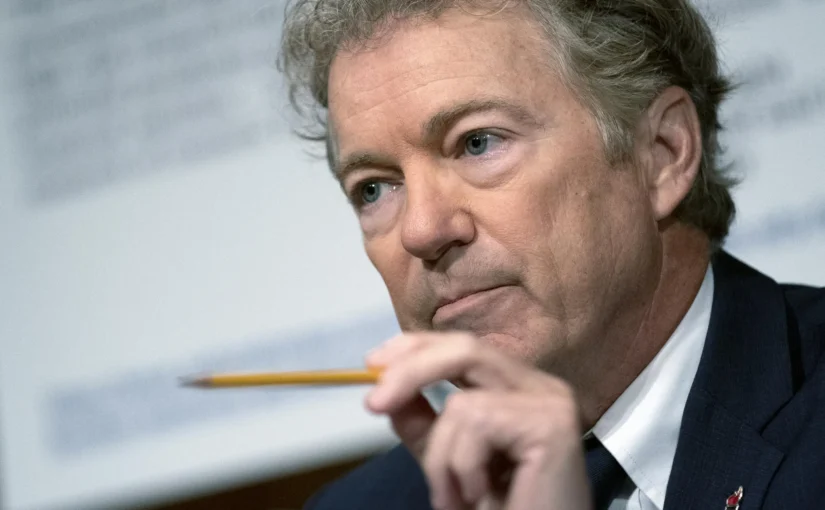
Flock has 120,000 cameras tracking cars across America, no warrant required. Over 5,000 police agencies have signed on. This isn't crime fighting. This is mass surveillance of every American, and a violation of our 4th Amendment rights. pic.twitter.com/LW67xSOAMN
This wasn’t public health — it was the feds weaponizing left-wing groupthink. Small businesses, kids, and doctors paid the price. https://t.co/3b4JUehxHp
During a Senate Homeland Security Committee hearing, Dr. Anthony Fauci invoked the Fifth Amendment to decline answering all questions, including basic factual inquiries. This strategy followed a preemptive presidential pardon, leading Senator Rand Paul to challenge the legal validity of Fauci’s constitutional protections in this context.
Chairman Rand Paul announced a forthcoming committee vote to hold Fauci in criminal contempt of Congress. The dispute centers on whether a pardoned official can maintain Fifth Amendment privileges during congressional oversight. If passed, the resolution will move to the full Senate for a potential legal showdown.
Fauci Pleads the Fifth
If you thought the Senate COVID-19 hearings couldn’t get any more surreal, this week’s confrontation reached a whole new level.
Subpoenaed by Senate Homeland Security Committee Chairman Rand Paul, Dr. Anthony Fauci sat at the witness table and refused to answer a single question. But he didn’t just refuse to discuss complex virology, grant paperwork, or lab protocols—he took the Fifth Amendment on basic reality.
Taking “Stonewalling” to an Absurd Extreme
In a memorable exchange designed to test whether Fauci was acting in good faith, Senator Josh Hawley posed a series of completely non-incriminating baseline questions:
What day of the week is it?
What color is the carpet in front of you?
What color tie are you wearing?
What does the Fifth Amendment actually say?
To every single question, Fauci deadpanned the exact same script: “On the advice of counsel, I respectfully decline to answer based upon my rights under the Fifth Amendment to the Constitution.” He even pleaded the Fifth when asked if a red folder was sitting on the table directly in front of him.
To millions of Americans watching at home, the spectacle was baffling. If a public official cannot even confirm the color of the tie around his neck without invoking constitutional protection against self-incrimination, it shows just how far he is willing to go to avoid under-oath questioning.
The Next Phase: The Impending Contempt Vote
Because President Biden granted Fauci a broad, preemptive presidential pardon before leaving office, Senator Rand Paul argued that Fauci no longer has valid Fifth Amendment protections for past conduct, as he cannot face federal prosecution for those acts.
Having formally overruled Fauci’s assertion of privilege during the hearing, Chairman Paul announced that the Senate Homeland Security Committee will hold an official vote next week on whether to hold Dr. Fauci in criminal contempt of Congress. If the committee passes the resolution as expected along party lines, it will head to the full Senate floor, setting up a constitutional legal showdown in federal court over whether a pardoned official can use the Fifth Amendment to stonewall congressional oversight.
📹 Watch the Viral Hearing Exchange
You can watch the video of the exchange between Sen. Josh Hawley and Dr. Anthony Fauci below:
If you watched the Senate hearings between Senator Rand Paul and Dr. Anthony Fauci, you saw a masterclass in how government bureaucrats try to dodge accountability—and how a real physician fights back.
On paper, the fight looked like a dispute over scientific jargon. But at its core, it was about a fundamental truth: did the U.S. government help fund dangerous virus research in Wuhan, and did the man in charge lie about it to Congress?
The Allegation: Playing Word Games with Public Safety
The main issue came down to something called gain-of-function research—the practice of taking an existing virus and genetically modifying it to make it more infectious or deadly to humans so scientists can study it.
During the hearings, Dr. Rand Paul brought the receipts. He pointed directly to published research papers showing that NIH grant money, funneled through an organization called the EcoHealth Alliance, funded experiments at the Wuhan Institute of Virology. In these experiments, bat coronaviruses were modified to see if they could infect human cells.
When Paul called him out for funding this high-risk research, Fauci pushed back aggressively, claiming under oath that the NIH never funded gain-of-function research in Wuhan.
How could Fauci claim that? By hiding behind bureaucratic definitions. Instead of using the commonsense definition of making a virus stronger, Fauci relied on a hyper-narrow, internal agency rulebook to argue that the experiments technically didn’t meet the official standard. To anyone paying attention, it was a classic semantic dodge: change the definition of the word, and suddenly you aren’t lying anymore.
Why Dr. Rand Paul Was the Right Person for the Job
Fauci relied on the assumption that politicians wouldn’t understand the complex science well enough to challenge him. But he ran into a major problem: Rand Paul isn’t just a politician. He’s a licensed medical doctor.
Because Dr. Paul has a formal background in medicine and science, he couldn’t be easily intimidated by medical jargon or authority titles. He understood the underlying biology. When Fauci attempted to dismiss his questions with technicalities, Dr. Paul saw right through the performance and refused to let him off the hook.
Dr. Paul stood up as a watchdog for the American public. He argued that when public officials fund potentially dangerous bioweapon-style research overseas using taxpayer dollars—and then try to hide behind bureaucratic loops when asked about it—it puts the entire world at risk.
The Takeaway
Fauci pushed back with polished, defensive rhetoric, but Dr. Paul did something far more important: he established a record. By using his background as a physician to cut through the smoke and mirrors, Dr. Paul showed the country that holding powerful officials accountable requires asking tough questions and refusing to accept semantic games as the truth.