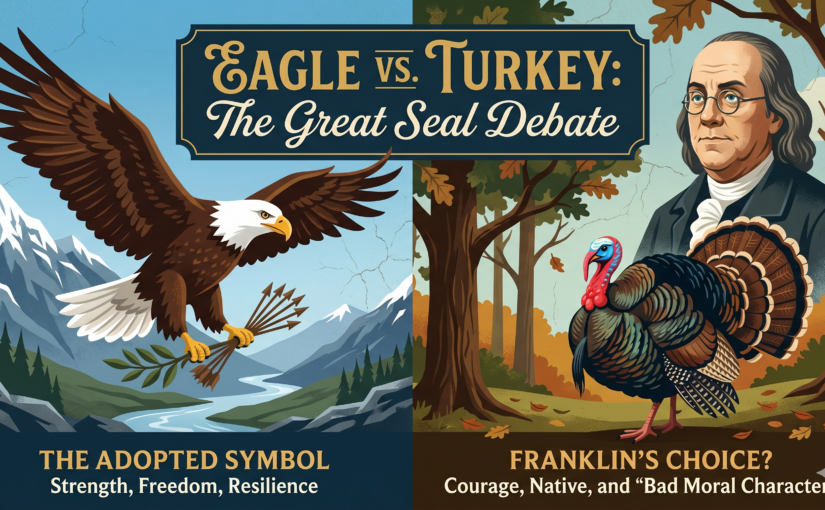
When we see the Bald Eagle today, perched regally on the back of a quarter or soaring over a river, it feels like an inevitable choice for a national symbol. It is fierce, majestic, and uniquely North American. However, the path to becoming the face of the United States was a six-year bureaucratic marathon that pitted the “King of Birds” against a surprising contender: the Wild Turkey.
The Six-Year Search
The quest for a national seal began on July 4, 1776, immediately after the Declaration of Independence was signed. It took three separate committees and nearly six years to land on a final design. While early iterations included everything from Lady Liberty to biblical scenes of Moses crossing the Red Sea, the third committee finally leaned into heraldry.
In June 1782, Charles Thomson, the Secretary of the Continental Congress, took the lead. He simplified previous designs, placing the American Bald Eagle at the center. With an olive branch in its right talon and thirteen arrows in its left, the eagle represented a nation that desired peace but was ready for war.
Franklin’s Famous Dissent
The most colorful objection to this choice came from Benjamin Franklin. Though he was a member of the first committee, his most famous critique wasn’t written in a legislative hall, but in a 1784 letter to his daughter, Sarah Bache.
Franklin was less than impressed with the eagle’s behavior. He wrote:
“For my own part, I wish the Bald Eagle had not been chosen the Representative of our Country. He is a Bird of bad moral Character. He does not get his Living honestly… besides, he is a rank Coward: The little King Bird, not bigger than a Sparrow, attacks him boldly and drives him out of the District.”
To Franklin, the Bald Eagle was a “thief” because it frequently harassed smaller raptors like Ospreys to steal their catch. In contrast, he championed the Wild Turkey. He admitted the turkey was a bit “vain and silly,” but argued it was a bird of courage and a “true original Native of America” that wouldn’t hesitate to protect its territory.
Symbolism vs. Reality
Despite Franklin’s witty observations, Congress stayed the course. They weren’t looking for a bird with the best “work ethic”; they wanted a symbol that projected sovereignty and power to the empires of Europe.
While Franklin viewed the eagle through the lens of a naturalist, the founders viewed it through the lens of history. They were tapping into the tradition of the Roman legions, positioning the young United States as a new kind of republic. Today, the Bald Eagle stands as a testament to that ambition—even if it does occasionally steal a fish or two along the way.
