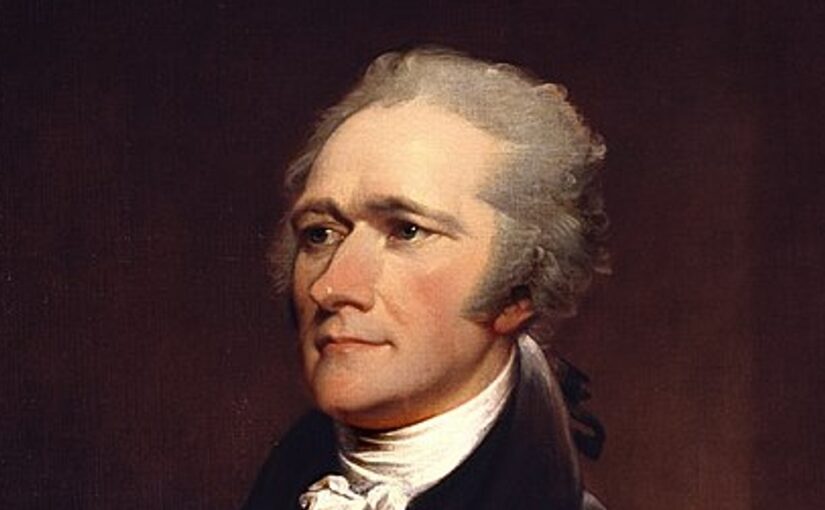
The Real Meaning Behind Hamilton’s Famous Quote
“I think the first duty of society is justice.”
It sounds like a modern plea for equity or fairness. You might expect to see it on a protest sign or in a civil rights essay. But when Alexander Hamilton wrote these words in August 1794, he wasn’t calling for social reform—he was calling for the army to march on American citizens.
To understand this quote, we have to look at the crisis that gave rise to it: the Whiskey Rebellion.
The Crisis
In the early 1790s, the young United States was fragile. To pay off war debts, Hamilton (as Treasury Secretary) had instituted an excise tax on distilled spirits. For farmers on the western frontier, whiskey wasn’t just a drink; it was a currency. They viewed the tax as tyranny.
By 1794, protests in Western Pennsylvania had turned violent. Tax collectors were tarred and feathered, and armed insurgents threatened to burn Pittsburgh. The authority of the federal government was crumbling.
The “Tully” Essays
Hamilton wrote a series of essays for the American Daily Advertiser under the pseudonym “Tully.” His goal was to convince the public—and President George Washington—that the government had a moral obligation to use military force to crush the insurrection.
In this context, Hamilton’s definition of “justice” was strictly legal and political. He wasn’t talking about fairness; he was talking about the Rule of Law.
Hamilton argued that:
- In a republic, laws are made by representatives elected by the majority.
- If a violent minority can simply choose to ignore those laws, the government has failed.
- Therefore, the “first duty” of society is to enforce its laws (justice) to protect the peace and liberty of the law-abiding majority.
The Legacy
Hamilton’s argument won the day. George Washington personally led a militia force of nearly 13,000 men into Pennsylvania—the first and only time a sitting U.S. President has led troops in the field. The rebellion dissolved without a major battle.
When you quote Hamilton today, remember the context. He wasn’t arguing for the government to be nicer; he was arguing that a government that cannot enforce its will is no government at all. For Hamilton, justice was the iron wall standing between civilization and anarchy.
Primary Source: “Tully No. III” by Alexander Hamilton
- Date: August 28, 1794
- Source: The American Daily Advertiser (Philadelphia)
- Original Text Link: Founders Online (National Archives)
