This is how it should have ended.

After everything they went through, they deserved the happiest ending.
This is how it should have ended.
After everything they went through, they deserved the happiest ending.
This is a reply to this letter.
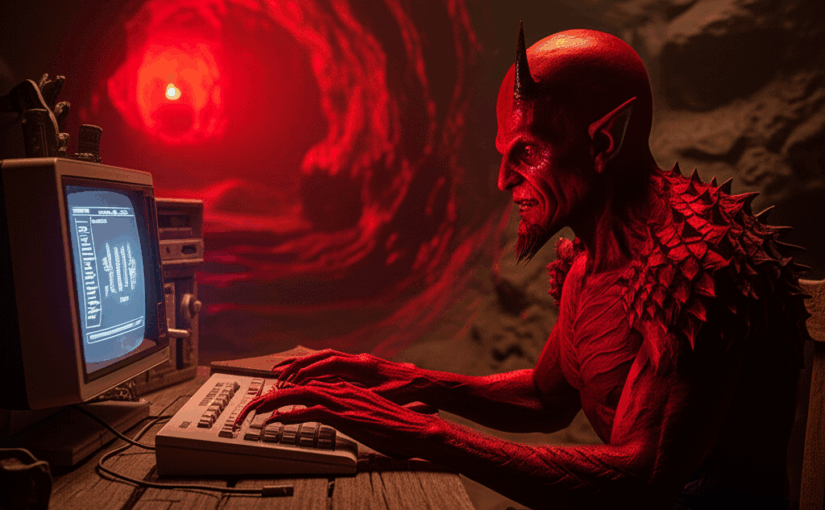
Uncle Screwtape,
I trust this missive finds you basking in the eternal fires, perhaps even enjoying a particularly choice vintage of human despair. Your last letter, outlining the exquisite potential of “social media,” was nothing short of revelatory. I have, with the utmost diligence (and a surprising amount of enjoyment), been applying your counsel, and I am thrilled to report on the Patient’s progress – or rather, regress.
The constant stream of comparison has been, as you predicted, a resounding triumph. I’ve ensured his feed is saturated with the triumphs of his peers – the exotic holidays, the dazzling promotions, the impossibly harmonious family photos. The Patient, bless his little human heart, now spends an inordinate amount of time scrolling through these curated fictions, his own perfectly adequate life curdling into a bitter paste of mediocrity. He sighs frequently, a delicious sound, and often mutters about “missing out.” He even attempted a rather pathetic imitation of a ‘perfect’ brunch photo himself, only to become frustrated when it didn’t garner the same effusive praise as his online acquaintances. A small victory, but a victory nonetheless, as it led to him snapping at his spouse, thereby chipping away at a genuine relationship for the sake of digital vanity.
The performative virtue is also blossoming beautifully. The Patient, once content to simply do good, now feels compelled to announce it. A small, anonymous donation became a lengthy post about his commitment to a cause, garnished with a carefully chosen, flattering selfie. He is more concerned with the ‘likes’ and ‘shares’ than the actual impact of his actions. I overheard him lamenting that a particularly thoughtful comment he made online received fewer reactions than a rather vapid meme. His motivation, once pointed towards the Enemy, is now firmly directed at the fickle approval of strangers. The genuine humility that once underpinned his charitable impulses is being slowly but surely replaced by a hollow pride.
The addiction to the trivial is perhaps my greatest success. The Patient, who once enjoyed reading substantial books or engaging in thoughtful hobbies, now finds his attention fractured. He picks up a book, glances at a page, and then, as if by an irresistible compulsion, reaches for his device. Hours dissolve into the digital ether, filled with endless scrolling through fleeting images and vapid pronouncements. The Enemy’s attempts at quiet contemplation are utterly drowned out by the incessant chatter of the online world. He complains of being tired, yet he cannot put the device down. It is glorious, Uncle, to watch his mind become a sieve, unable to hold onto anything of lasting significance.
The righteous indignation has been particularly gratifying to cultivate. The Patient, once a fairly peaceable fellow, now seethes with a righteous anger over minor online disagreements. He has discovered the intoxicating thrill of the “comment section,” where he can unleash his thinly veiled frustrations upon anonymous adversaries. Charity evaporates, replaced by a self-righteous fury. He spends more time arguing with strangers about politics or trivial matters online than he does engaging in meaningful conversation with his actual loved ones. I’ve even nudged him towards a few particularly inflammatory posts, watching with glee as he takes the bait, his temper flaring, his heart hardening towards his fellow man.
And finally, the pervasive sense of isolation is truly reaching its peak. Despite having hundreds of “connections,” the Patient feels profoundly alone. He avoids real-life social gatherings, preferring the curated, low-effort interactions of the digital realm. He believes he is “connected,” yet he rarely experiences true intimacy or vulnerability. He shares trivial updates with a vast audience, but rarely confides his deepest fears or joys to a trusted friend. This subtle yet profound loneliness, I predict, will be a rich source of despair for years to come.
In short, Uncle, the Patient is becoming a perfectly self-absorbed, easily distracted, and perpetually dissatisfied creature, all thanks to the ingenious machinery of social media. He is less engaged with the world around him, less connected to real people, and far, far less attentive to the Enemy’s tiresome whispers.
Thank you, dear Uncle, for this most excellent instruction. I eagerly await your next pronouncements.
Your devoted (and increasingly successful) nephew,
Wormwood
Israel
In a shocking escalation of holiday-season tensions, palace officials confirmed today that King Saul attempted to pin young David to the wall after catching him playing Christmas music before the official start of the Thanksgiving feast.
Witnesses say the incident occurred early in the morning when David, freshly caffeinated and apparently feeling festive, began strumming what sources are calling “an unmistakably jolly rendition” of Joy to the World on his lyre.
According to one palace servant, Saul froze mid-bite of his pre-breakfast turkey leg.
“He looked confused at first,” the servant reported. “Then horrified. Then the king whispered, ‘It’s still November… he wouldn’t dare.’”
Moments later, Saul allegedly bellowed, “NOT BEFORE THE HARVEST FESTIVAL!” and hurled his royal spear across the room. David dodged the projectile—reportedly with the same agility he later used against a large Philistine and, also, small children trying to steal cookies cooling on the palace windowsill.
When questioned about the incident, David shrugged.
“I don’t see the problem,” he said, tuning his lyre. “The earlier the Christmas music starts, the sooner people feel joy. Also, Saul asked for something ‘uplifting.’ I thought he meant ‘Mariah-adjacent.’”
Royal advisors were quick to clarify that while King Saul does enjoy holiday cheer, he believes all Israelites should adhere to the strict Fall Festival First policy, which requires gratitude-themed celebrations, pumpkin-spice sacrifices, and ceremonial reenactments of “that time the Lord gave us food even though we definitely didn’t deserve it.”
Public reaction has been mixed.
Some citizens agree with Saul, insisting it is a slippery slope from early carols to year-round garland. Others defend David, claiming that if you don’t start at least lightly humming carols in mid-autumn, you’ll never be emotionally prepared for December.
In response to the uproar, palace musicians have proposed a compromise: no Christmas music until after the Thanksgiving offering—but sleigh bells may be jingled quietly in private as long as they do not exceed “moderate festivity.”
Meanwhile, Saul’s spear has been retrieved and placed back on its ceremonial hook, though officials admit it may see action again if David even thinks about playing Feliz Navidad before the Feast of Booths.
David, however, remains undeterred.
“Next week I’m introducing the king to the concept of Christmas lights,” he said. “Pray for me.”
Why would you remove the literal cracker barrel from the Cracker Barrel logo?

The logo featured an actual wooden barrel—a nod to the store’s name and its inspiration from old country stores, where barrels of crackers were a common sight. The barrel was a central visual element, reinforcing the brand’s nostalgic, rustic identity.
My Dearest Wormwood,
I trust this letter finds you in good spirits, or at least, in a suitably malicious state of being. Your last report concerning the Patient was… adequate. Adequate, Wormwood, is hardly the standard we aim for in the Lowerarchy. Still, I detect a burgeoning aptitude for subtle corruption within you, and that, at least, is something.
You asked, rather clumsily, about this new human invention: the “social media.” A delightful development, Wormwood, a truly exquisite tool in our eternal struggle. When first the Enemy inspired His creatures with the desire for community, He likely envisioned something rather… different. But we, my dear nephew, have long specialized in the perversion of good.
Here, then, is how you are to wield this weapon:
Firstly, encourage a constant stream of comparison. The Patient, being human, is already susceptible to the sin of envy. Social media amplifies this beautifully. Let him see the meticulously curated lives of others – their sun-drenched holidays, their perfectly presented meals, their impossibly cheerful children. He must never suspect the artifice, the careful cropping, the dozens of failed attempts that lie behind each triumphant post. His own humble existence will, by comparison, seem dull, inadequate, and utterly lacking. This breeds dissatisfaction, a fertile ground for resentment against the Enemy’s supposed neglect.
Secondly, foster a spirit of performative virtue. The humans, in their pathetic attempts at goodness, often seek approval. On these platforms, however, the approval becomes the end, not the means. Let the Patient post grand pronouncements of his moral rectitude, his charitable donations, his profound insights. He must feel a rush of self-congratulation with each ‘like’ or ‘share.’ The danger, Wormwood, is that he might actually do good in the quiet, unseen places. Social media encourages him to perform it loudly, for an audience. This saps the true humility from his actions, turning genuine compassion into mere exhibition.
Thirdly, cultivate an addiction to the trivial. The Enemy, in His tiresome way, wishes for His creatures to contemplate eternity, to ponder deep truths, to engage in meaningful relationships. We, on the other hand, thrive on distraction. The “feed,” as they call it, is a veritable river of superficiality. Let the Patient scroll endlessly, consuming bite-sized morsels of information, amusing memes, and outrage-inducing headlines. He must never settle on one thing long enough to truly consider it. His attention span must become as fleeting as a butterfly’s wing. This constant mental chatter leaves no room for quiet reflection, for prayer, or for truly listening to the Enemy’s whisper.
Fourthly, incite righteous indignation. This is a particularly potent brew. When the Patient encounters opinions contrary to his own, or even slightly misaligned, encourage him to respond with immediate, unthinking fury. The anonymity of the screen is a wonderful shield for venom. Let him join the digital mobs, hurl insults, and feel the intoxicating surge of moral superiority. This breeds division, destroys charity, and, most importantly, directs his anger at his fellow humans rather than where it truly belongs – at us!
Finally, and perhaps most subtly, ensure a pervasive sense of isolation. While these platforms ostensibly connect humans, they often foster a deeper loneliness. The Patient will have hundreds, even thousands, of “friends,” but few, if any, genuine confidantes. Encourage him to rely on these digital interactions for all his social needs, neglecting face-to-face encounters, the messy, inconvenient reality of true relationship. He will feel seen, but never truly known. He will receive affirmation, but never true understanding. This void, my dear Wormwood, is a fertile ground for despair, which is, as you know, one of our most cherished crops.
Remember, Wormwood, our objective is not simply to make the Patient ‘bad,’ but to make him ineffective, distracted, and ultimately, lukewarm. This “social media” is a tool perfectly suited to this end. Employ it with diligence, and you shall earn yourself a hearty feast of grubs.
Your affectionate Uncle,
Screwtape
In the jungle of Whoville, one fine day,
Horton the elephant was heard to say,
“I hear a strange sound, oh my, oh me!
It’s like a whooshing, a whirling, a cosmic spree!”
Out of the TARDIS, in a flash of blue,
Appeared the Doctor, both quirky and true.
With a bowtie so bold and a sonic so keen,
He told Horton, “Hello there, I’m the Doctor, I’ve been!”
Horton blinked twice, his ears all a-flap,
“Who are you, sir, in this strange mishap?”
The Doctor grinned wide, his eyes full of glee,
“I’m the Time Lord from Gallifrey, that’s me!”
Horton, amazed, trumpeted a cheer,
“Time travel, you say? That’s perfectly clear!
I’m an elephant with a heart that’s grand,
Let’s explore the universe; together we’ll stand!”
So off they went, on adventures so grand,
Through time and space, across the land.
With the TARDIS and Horton, an unlikely pair,
They journeyed on, a duo beyond compare.
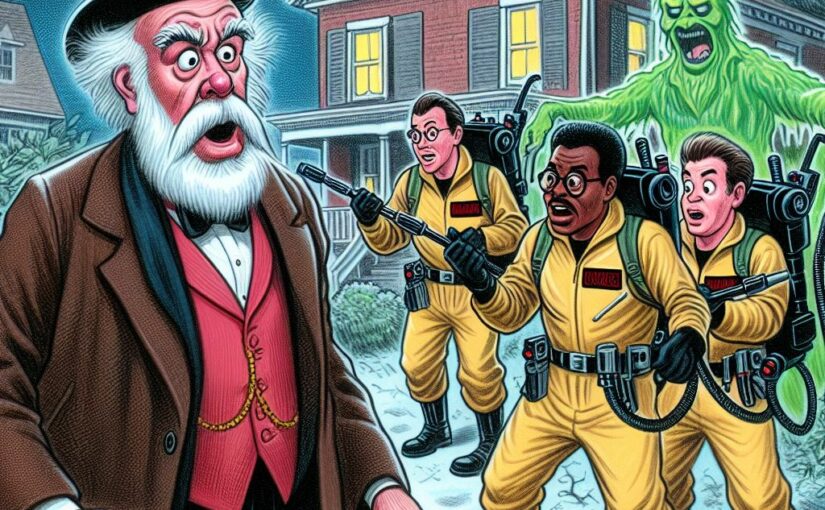
Once upon a time in the heart of London, the Ghostbusters faced a peculiar case that went beyond their usual spectral encounters. Late one cold and foggy Christmas Eve, the call came in from none other than Ebenezer Scrooge himself. The notorious miser and tight-fisted old man had a ghost problem that even he couldn’t ignore.
Always up for a challenge, the Ghostbusters quickly assembled their proton packs and headed to Scrooge’s gloomy mansion. They were greeted by the elderly man with a mix of skepticism and desperation.
“Ghostbusters, you say?” Scrooge grumbled. “I don’t believe in such nonsense, but these spirits won’t leave me be! They’re ruining my business and haunting my sleep. I demand you rid me of them!”
Undeterred by Scrooge’s skepticism, the Ghostbusters thoroughly investigated the mansion. The air was thick with the presence of otherworldly entities, and the team soon realized that these weren’t just ordinary ghosts. They were the spirits of Christmas Past, Present, and Future – the very apparitions that had visited Scrooge the night before.
Dr. Peter Venkman, always the one with a quick wit, remarked, “Looks like someone had a Dickens of a night, huh?”
As the Ghostbusters delved deeper into the spectral mystery, they discovered that the spirits were trapped in a temporal loop, repeatedly replaying the events of Scrooge’s transformation. The team knew they had to break the cycle to free Scrooge and the restless spirits.
With a combination of scientific prowess and a touch of holiday magic, the Ghostbusters devised a plan. Using their proton packs, they synchronized their energy emissions to disrupt the temporal loop. The spirits were temporarily halted as the beams of energy intertwined, and the team entered the ethereal realm.
In a surreal landscape that mirrored Scrooge’s memories, the Ghostbusters encountered each spirit separately. With their scientific know-how, they convinced the Ghost of Christmas Past, Present, and Future to release their hold on Scrooge. As the temporal loop unraveled, the spirits faded away, leaving a sense of peace behind.
Back in the real world, Scrooge couldn’t believe his eyes as the apparitions disappeared. He stood in his mansion, surrounded by the Ghostbusters and a newfound warmth in his heart.
“Thank you,” Scrooge whispered, his once-icy demeanor melting away. “I never thought I’d say this, but Merry Christmas, Ghostbusters!”
The Ghostbusters tipped their proton packs in acknowledgment and left the transformed Scrooge to enjoy the rest of his Christmas Eve. As they exited the mansion, the team shared a moment of satisfaction, knowing that they saved Scrooge from his ghostly predicament and brought a little more joy to the world on that magical Christmas night.
Generative AI is a technology that can create realistic photos and art from text prompts or other inputs. It sounds like a fun and exciting way to unleash your creativity, but it also has some serious ethical and legal implications that you should be aware of.
One of the main problems with generative AI is that it relies on large datasets of existing images and text to learn from and produce new content. This means that it may use copyrighted or trademarked works without the permission or compensation of the original artists or owners¹. It may also create images that are too similar or derivative of existing works, violating the rights of the creators and devaluing their work.
Another issue with generative AI is that it blurs the definition and value of art. Art is supposed to be a human expression of creativity, emotion, and skill, but generative AI can produce images that are indistinguishable from human-made ones, or even surpass them in quality and speed⁴. This raises questions about the authenticity, originality, and meaning of art, as well as the role and responsibility of the artist³.
Generative AI also poses a threat to the integrity and credibility of photography and art. It can create fake or misleading images that can be used for propaganda, misinformation, or manipulation⁵. It can also erode the trust and appreciation of the audience, who may not be able to tell what is real and what is generated by an algorithm.
Generative AI is not inherently bad or evil, but it is a powerful tool that can be used for good or evil purposes. It can also have unintended consequences that may harm the artists, the industry, and the society. Therefore, it is important to be aware of the risks and challenges of using generative AI for photography and art, and to use it responsibly and ethically.