On June 12, 2026, SpaceX completed the largest IPO in history, raising ~$75 billion and soaring to a $1.77–2+ trillion valuation. More than 4,400 current and former employees—from engineers to welders and support staff—saw their equity grants turn into at least $1 million each. Roughly 400 now hold $100 million+ stakes!
This massive wealth creation highlights the power of employee ownership at one of America’s most innovative companies. While shares remain subject to lock-ups and taxes, it’s a remarkable milestone for the team building our multiplanetary future.
What an inspiring success story! 🇺🇸
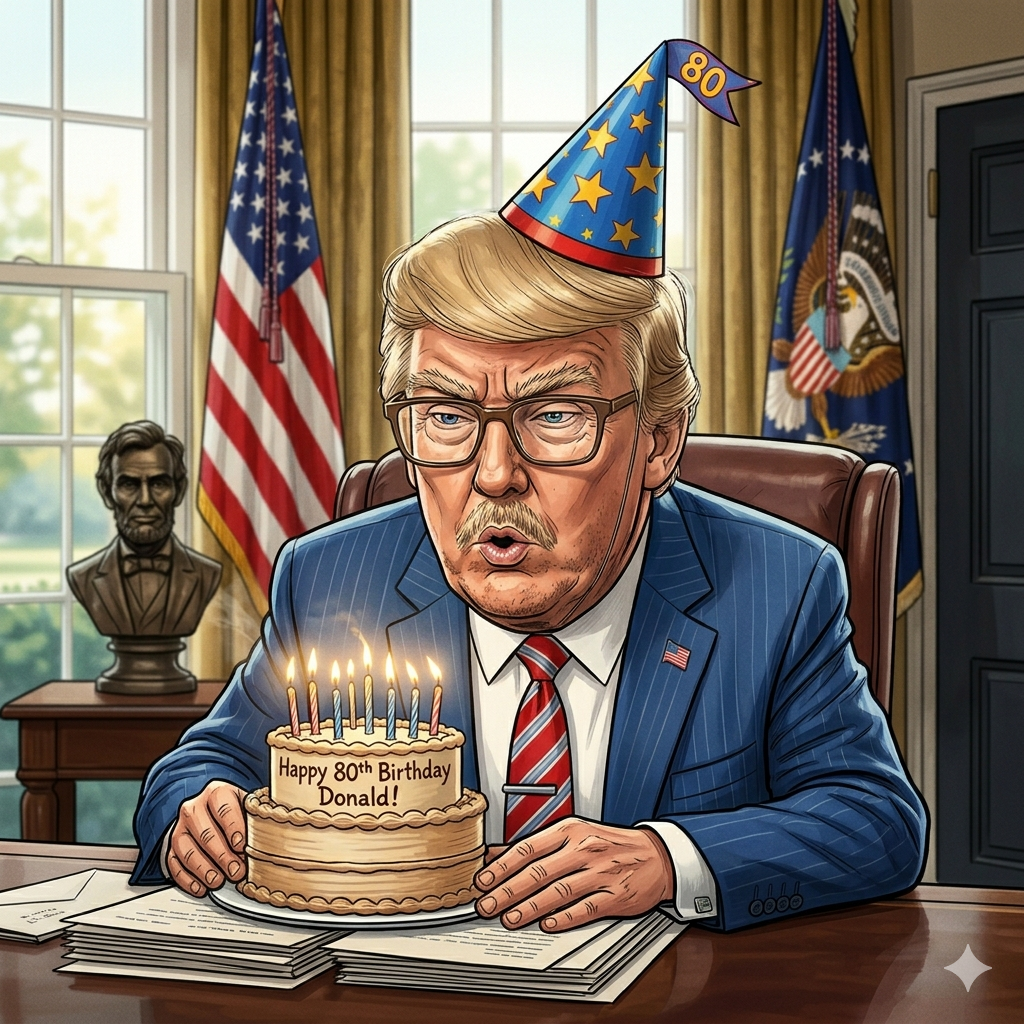
Happy 80th Birthday
Wishing a very Happy 80th Birthday to @realDonaldTrump! 🎂🇺🇸 Hope it’s a great one spent with family, friends, and plenty of cake!
Always thought of @elonmusk more like Tony Stark — genius billionaire playboy philanthropist building the future. But with this kind of money incoming? Batman arc confirmed. 驪 ‘I’m Elon… I mean, I’m Batman.’
Elon Musk Confirms He Will Soon Have Enough Money To Become Batman
The world’s first trillionaire is an African-American. Why do Democrats hate him?

For a Good Time Call…
Jeopardy! really missed an opportunity last week. They had a category, “For a Good Time Call,” and they did not use a clue like this. 🤔 Every clue had a phone number in it.


Reclaiming the Rainbow
🌈 The Story Behind the Rainbow 🌈
Every time we see a rainbow stretch across the sky, it’s a beautiful reminder of one of the oldest promises in history. In the book of Genesis, after the great flood, Noah, his family, and the animals finally stepped out of the ark onto dry land. God set a rainbow in the clouds as a visual covenant—a permanent promise to Noah and every living creature that He would never destroy the earth with a flood again.
It’s not just a beautiful view; it’s a timeless symbol of mercy, faithfulness, and new beginnings. Next time you see one after a storm, take a second to remember that no matter how dark the clouds get, a promise of hope always follows!
✨ “I have set my rainbow in the clouds, and it will be the sign of the covenant between me and the earth.” — Genesis 9:13 ✨

Betsy Ross: History vs. Myth
This post is part of an ongoing series, America 250.
We all know the image: Betsy Ross sitting in a sun-drenched room, hand-stitching the first Stars and Stripes. It’s a beautifully patriotic scene that we’ve been taught since elementary school. But what if the “First Flag” was actually a product of unpaid bills, 6-pointed stars, and a signer of the Declaration of Independence looking for payment in wine?
As we approach America’s 250th anniversary, it’s the perfect time to peel back the layers of our national folklore. The real story of how the American flag came to be isn’t just about one woman with a needle and thread—it’s a fascinating look at wartime bureaucracy, design debates, and a PR campaign that started a century after the revolution.
The Wine-Loving Designer (Who Wasn’t Washington)
The legend tells us that George Washington, George Ross, and Robert Morris walked into Betsy’s Philadelphia upholstery shop in 1776 with a rough sketch in hand. In reality, Washington was a bit busy trying to keep the Continental Army from collapsing, and there is zero contemporary paperwork proving this meeting ever happened.
Instead, historical evidence points toward a man named Francis Hopkinson.
Hopkinson was a Renaissance man: a lawyer, a musician, a signer of the Declaration of Independence, and a member of the Continental Navy Board. He is the person who actually designed the flag elements. How do we know? Because he later sent a bill to Congress asking for payment for his design work. His requested fee? A quarter-cask of public wine. (Congress, being Congress, delayed and ultimately never paid him, arguing that others contributed to the design too).
The Six-Pointed Showdown
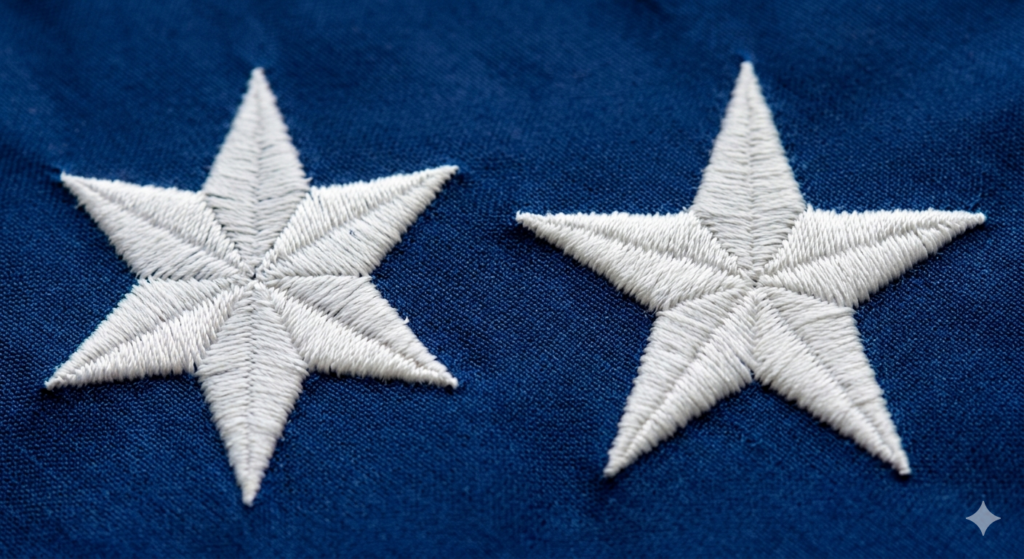
When Hopkinson or the committee originally drew up the stars, they weren’t the 5-pointed ones we know today. They featured 6-pointed stars (hexagrams), which were the standard in British heraldry.
This is where Betsy Ross likely does enter the story. According to oral history passed down by her family, the committee wanted 6-pointed stars because they thought they would be easier to sew. Betsy allegedly took a piece of paper, folded it strategically, and with a single, elegant snip of her scissors, produced a perfect 5-pointed star.
She proved that the 5-pointed star was actually more efficient for mass production. Whether this snippet of history is entirely true or not, the visual shift was profound: it gave the new nation a unique aesthetic, distinct from the British crown.
The Math Problem: Too Many Stripes
We take the 13 stripes and 50 stars for granted today, but the early evolution of the flag was absolute chaos. The original 1777 Flag Resolution was incredibly vague. It simply stated that the flag would have 13 alternating red and white stripes, and 13 white stars in a blue field, representing a “new constellation.”
It didn’t specify how the stars should be arranged (which is why you see early flags with stars in circles, rows, or clusters), nor did it map out a plan for growth.
When Vermont and Kentucky joined the Union, the flag was changed to 15 stars and 15 stripes (this was the “Star-Spangled Banner” that Francis Scott Key saw over Fort McHenry). But as more states lined up to join, Congress realized that adding a new stripe for every state would turn the flag into an unmanageable, oversized blanket. In 1818, they wisely capped the stripes permanently at 13 to honor the original colonies, letting only the stars multiply.
The Hidden Code of the Colors
While the design was being ironed out, the symbolism was being codified. When the Great Seal of the United States was adopted in 1782, the meanings of the flag’s colors were officially defined:
- White: Signifies purity and innocence.
- Red: Represents hardiness and valor.
- Blue: Represents the chief, vigilance, perseverance, and justice.
The stars, collectively, were meant to break away from the old world—a literal new constellation rising in the global political heavens.
So, Was Betsy Even the Original Seamstress?
Here is the ultimate plot twist: the world didn’t hear about the “Betsy Ross” story until 1870—nearly a century after the Declaration of Independence. Her grandson, William Canby, presented the story to the Historical Society of Pennsylvania based purely on family affidavits and memories.
Did Betsy Ross exist? Absolutely. Was she a skilled Philadelphia upholsterer? Yes. Did she make flags for the government? Records show she was paid for making ship colors for the Pennsylvania navy.
While she may not have single-handedly “invented” the American flag in a vacuum, Betsy Ross represents something incredibly vital to the America 250 story. She represents the thousands of women, tradespeople, and working-class colonists who didn’t sign the grand documents, but who used their tangible, everyday skills to physically sew the revolution together.
The myth gives us a neat story, but the history gives us a beautiful truth: the American flag was a group project.
Waiter, what’s this bug 🐛 doing in my soup?
The bug looks up and says, “I’m just doing the backstroke!”
Classic dad energy activated. 🪳🍲
Dirty Mountain Dew
A Creamy Citrus Twist on the Dirty Soda Trend
Mountain Dew launched its first ready-to-drink take on the dirty soda craze in 2026 with Dirty Dew (and its Zero Sugar counterpart). This permanent flavor blends the brand’s signature bold citrus taste with a smooth, creamy finish. Official notes highlight vanilla-forward creaminess layered over lemon-lime and orange citrus, creating a bright yet indulgent profile. Many tasters describe it as cream soda meets Mountain Dew, with hints of key lime or vanilla float.
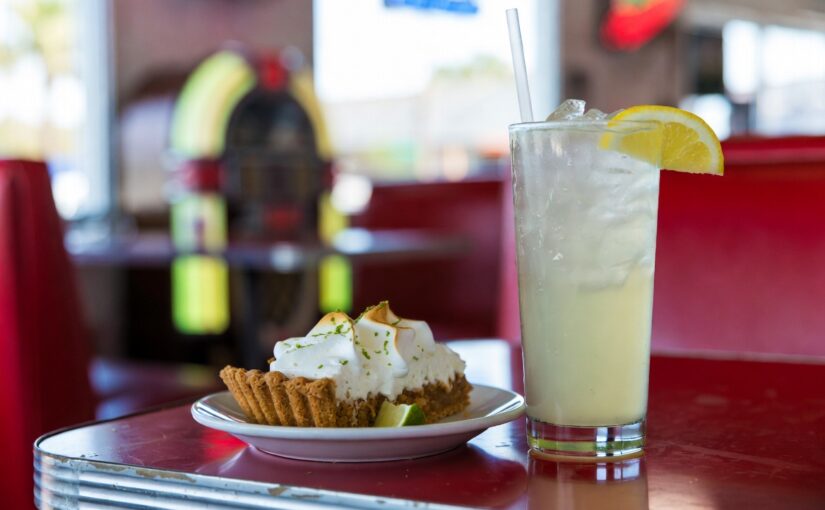
I recently tried the Zero Sugar version. It delivers flavors of key lime pie topped with whipped cream. The creamy vanilla hits first, followed by tart citrus that feels like a lighter, fizzy dessert. It’s refreshing and fun, though like most zero-calorie sodas, it carries a slightly unpleasant chemical aftertaste from the sweeteners. Overall, I rate it a solid 4.5 stars—strong enough to repurchase, but that tail keeps it from perfection. The full-sugar version is reportedly smoother for those who can handle the calories.
What Are Dirty Sodas?
Dirty sodas originated in Utah around 2010, popularized by shops like Swig. They typically start with a soda base and “dirty” it up with cream, flavored syrups, or fruit purees—offering customizable, indulgent drinks in a state with a large Mormon population that often avoids alcohol and coffee. Thanks to TikTok, the trend exploded nationwide. PepsiCo is jumping in with Dirty Dew to capture Gen Z’s love for bold, shareable flavors and beverage customization, turning a regional phenomenon into mainstream packaged convenience.
If you enjoy creamy citrus combos, Dirty Dew is worth a try. It’s a clever evolution of Mountain Dew for the dirty soda era.
Related Posts:
The opening bars of ‘Old Time Rock and Roll’ invariably evoke an image of Tom Cruise in his underwear, a mental association I doubt I’m alone in making, particularly among those who spent their teenage years in the 80s. 🎸