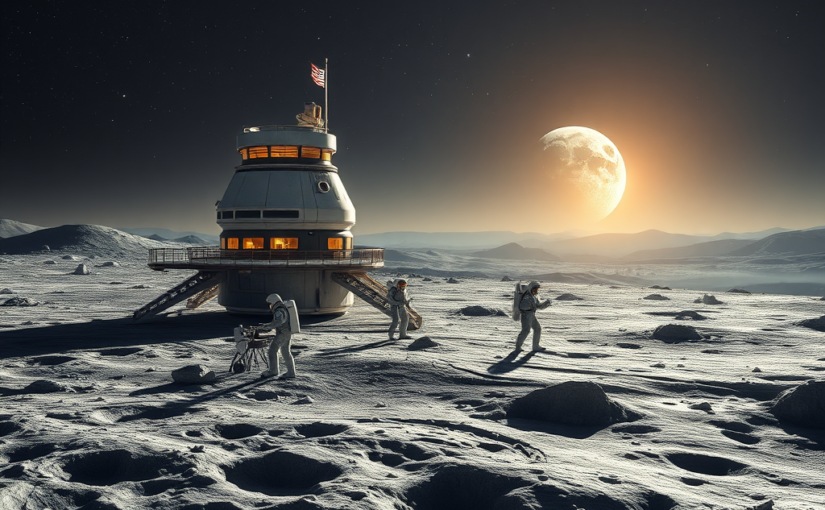
A Step Toward Becoming an Interplanetary Species
It’s been over 50 years since humans last walked on the Moon. That gap feels like a missed opportunity—and a wake-up call. Elon Musk has long argued that humanity must become a multiplanetary species to ensure our long-term survival. A single-planet civilization is vulnerable to existential risks: asteroid impacts, climate catastrophes, pandemics, or even self-inflicted disasters. Spreading life beyond Earth isn’t just ambitious—it’s insurance for consciousness itself.
The Moon is the smartest place to start. It’s our closest neighbor, making it far easier, cheaper, and faster to reach than Mars. Travel time is measured in days rather than months, communication delays are minimal, and rescue or resupply missions are realistic. A permanent lunar base serves as a critical proving ground for the technologies we’ll need on Mars: life support systems for long-duration stays, in-situ resource utilization (turning local materials into fuel, water, and oxygen), radiation shielding, sustainable habitats, and high-cadence reusable landings.
Musk has emphasized that while Mars is the ultimate goal for a self-sustaining civilization (thanks to its atmosphere, resources, and day length closer to Earth’s), the Moon offers a quicker path to a “self-growing” outpost—potentially in under 10 years versus 20+ for Mars. This isn’t a distraction; it’s acceleration. Recent shifts in focus highlight the Moon as a stepping stone that builds real operational experience and reduces risks for deeper space travel.
Beyond survival, a Moon base unlocks practical benefits:
Scientific discovery: Access to water ice at the poles, unique geology, and a stable platform for telescopes free from Earth’s atmosphere and radio interference.
Economic opportunity: An emerging lunar economy in mining (helium-3 for potential fusion energy, rare earth elements), commercial cargo, and infrastructure that spurs innovation and jobs back on Earth.
Inspiration and unity: Returning humans to the lunar surface—especially with diverse crews—reignites the exploratory spirit that drove Apollo and inspires the next generation of engineers and scientists.
NASA’s Artemis program and private efforts like SpaceX’s Starship are turning this vision into reality. Building a base isn’t about “flags and footprints”—it’s about learning to live and work off-world sustainably.
In short, going back to the Moon isn’t a nostalgic rerun. It’s the practical first leap toward making humanity interplanetary. As Musk puts it, the alternative to becoming multiplanetary is risking extinction on a single vulnerable world. The Moon gets us moving—faster, safer, and with momentum—toward cities on Mars and a future among the stars.
The high-water mark of our civilization shouldn’t be stuck in 1972. It’s time to go back, stay, and build. The universe is waiting.
